
Richie Rich
Intelligent Multi-Asset Portfolio Tracker
Download the Richie Rich Presentation
Elevator Pitch
Richie Rich is a real-time portfolio management dashboard that tracks stocks, crypto, and commodities across global markets in a single unified interface. Built on GridDB’s time-series capabilities, it stores granular price data, generates machine-learning-driven insights, and automates weekly performance reports using GitHub Actions.
Links
- Live Demo: Richie Rich (Vercel App)
- GitHub Repository: https://github.com/tejas6996/grib
- Video Demo: https://drive.google.com/file/d/19kaGcvQ35XcBRZejvS1VzzyeDHv9hSgG/view
About the Project
Motivation
Modern hedge funds manage portfolios spanning:
- Global equities
- Cryptocurrencies
- Commodities
- Derivatives
However, today’s tooling is fragmented:
- Bloomberg terminals for US equities
- Specialized NSE tools for Indian markets
- Separate crypto exchange dashboards
- Independent commodity tracking platforms
This fragmentation introduces information latency and increases operational overhead.
Richie Rich was built as a unified platform that:
- Aggregates real-time multi-asset data
- Stores granular historical price movements
- Powers predictive models to identify alpha-generating opportunities
Traditional relational databases struggle with high-frequency financial tick data. GridDB’s time-series architecture provides optimized write performance and queryable history, enabling price updates every 15–20 seconds without bottlenecks.
Technical Architecture
System Components
1. Backend Layer
- FastAPI server orchestrating data ingestion
- Sources:
- CoinGecko API (cryptocurrency prices)
- Simulated models (equities)
- Async price fetching with exponential backoff
- Background worker persists snapshots to GridDB every 20 seconds when frontend activity is detected
2. Storage Layer
- GridDB Cloud – TIME SERIES container
- Optimized for chronological writes
Schema:
{ timestamp, symbol, price, change24h }
- Row key collision handled via millisecond-offset timestamps for concurrent multi-symbol inserts
3. Presentation Layer
- React 18 + TypeScript
- Vite build tooling
- Tailwind CSS styling
Portfolio Valuation Formula:
V_portfolio = Σ (Qi × Pi)
Where:
Qi= quantity heldPi= current market price
Weighted 24h Performance:
Δ24h = (Σ (Qi × Pi × change_i,24h)) / V_portfolio
Machine Learning Integration
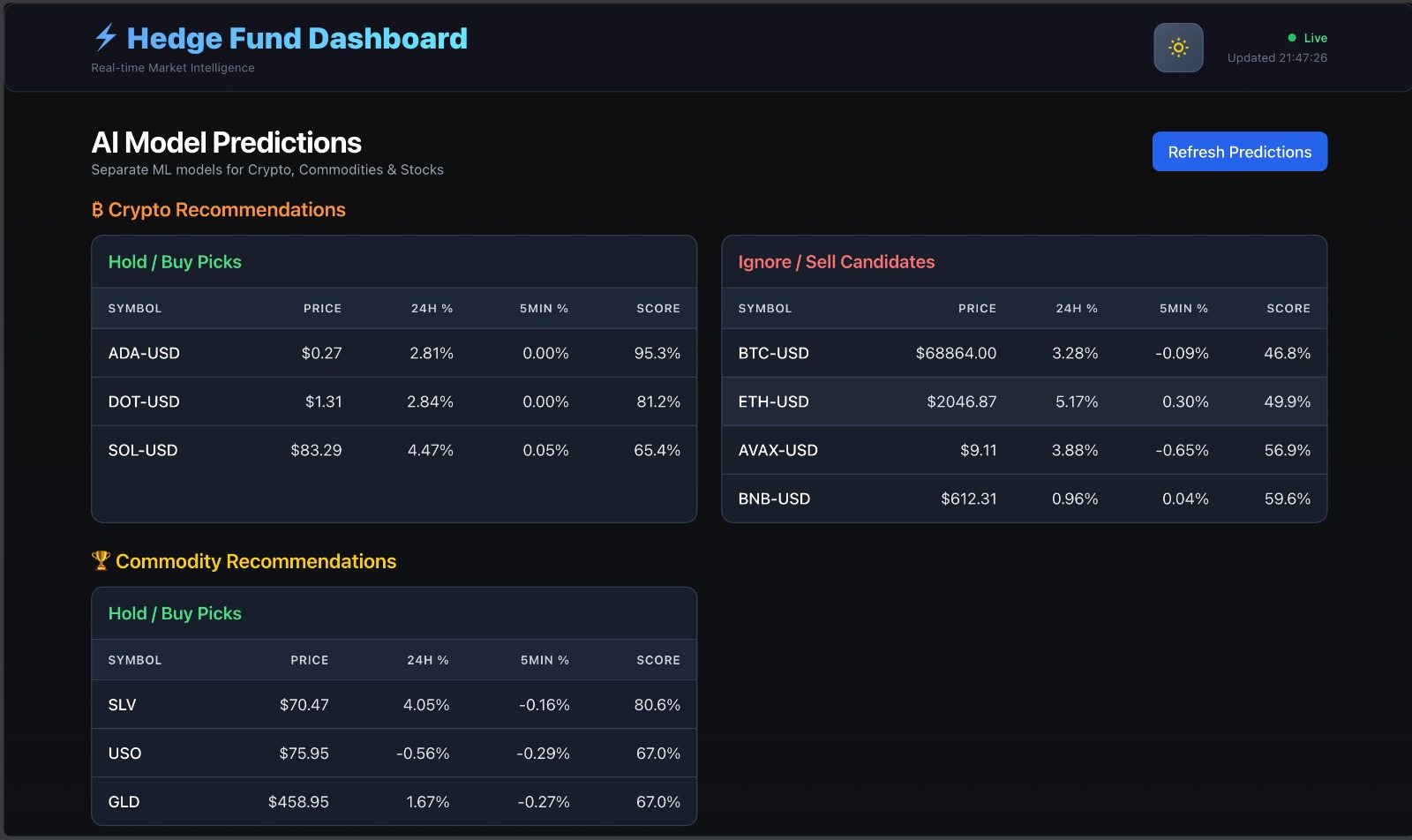
- XGBoost classifier for buy / sell / hold recommendations
- Feature engineering from GridDB historical data:
Features = { price, Δ24h, highest, lowest, range, range% }
- Model trained on
stockPrice.csv - Recommendations exposed via
/recommendationsAPI endpoint
Planned Enhancements:
- Time-series forecasting models
- Moving averages and correlation matrices using GridDB aggregations
Automation Infrastructure
A GitHub Actions workflow automates weekly portfolio exports:
- Triggered via:
- Cron (Sunday, 00:00 UTC)
- Manual dispatch
- Fetches portfolio state from backend
- Exports timestamped CSV to
/data - Commits and pushes via bot credentials
- Artifacts retained for 90 days
This provides auditable performance history for compliance and backtesting.
Key Learnings
Time-Series Databases Matter
- GridDB’s TIME SERIES containers align naturally with financial analysis
- Traditional RDBMS indexing fails at scale for time-ordered inserts
Row Key Semantics
- TIME SERIES containers use timestamps as row keys
- Concurrent inserts caused overwrites
- Solved via millisecond offsets per symbol
Real-Time API Limitations
- CoinGecko rate limits
- Yahoo Finance blocks automation
- Required caching, fallback logic, and exponential backoff
Frontend Performance
- Polling every 15 seconds stresses React state
- Proper
useEffectcleanup was critical to avoid memory leaks
Realistic Price Modeling
- Initial static pricing produced no visible movement
- Correct approach:
price_fluctuated = price_base × (1 + Δpct / 100)
GitHub Actions Permissions
- Default
GITHUB_TOKENis read-only - Required:
permissions: contents: write
Development Timeline
Week 1:
- FastAPI endpoints
- React frontend with mock data
Week 2:
- CoinGecko integration
- Real-time valuation logic
- Async background tasks
Week 3:
- GridDB Cloud deployment
- TIME SERIES container setup
- Row key collision fixes
Week 4:
- XGBoost ML model
- Recommendation API
- Glassmorphic dark UI
Week 5:
- Price fluctuation bug fixes
- Render + Vercel deployment
- CORS configuration
Week 6:
- GitHub Actions automation
- Weekly CSV exports
- Cron scheduling
Current System Features
- Real-time tracking for 10 assets
- Automatic GridDB persistence every 20 seconds
- Portfolio valuation with weighted 24h performance
- ML-powered buy/sell/hold recommendations
- Weekly automated CSV exports
- Responsive glassmorphic UI
- REST API with CORS support
- Environment-based configuration
Technical Challenges & Solutions
GridDB Authentication
- Requires Base64-encoded Basic Auth header
- Exact formatting needed to avoid 401 errors
TIME SERIES Row Key Collisions
- Solved using millisecond offsets per symbol
API Rate Limiting
- CoinGecko free tier: 50 calls/min
- Implemented exponential backoff + caching
React Interval Bugs
- Improper cleanup caused overlapping fetches
- Fixed with strict dependency management
GitHub Actions Issues
- Workflow location requirements
- Token permissions
- Deprecated actions upgraded
Deployment Connectivity
- Render free tier uses dynamic IPs
- GridDB Cloud free tier requires static IPs
- Documented as a known limitation
Production Solutions:
- Paid GridDB tier
- Static IP proxy
- Same-VPC deployment
Technology Stack
Backend
- Python 3.11
- FastAPI
- Uvicorn
Frontend
- React 18
- TypeScript
- Vite
- Tailwind CSS
Database
- GridDB Cloud (TIME SERIES)
Machine Learning
- XGBoost
- pandas
- numpy
APIs
- CoinGecko
- GridDB WebAPI
- Simulated equity models
DevOps
- GitHub Actions
- Render (backend)
- Vercel (frontend)
Summary
Richie Rich demonstrates how a dedicated time-series database like GridDB enables high-frequency financial data ingestion, real-time analytics, and machine-learning-driven insights. By unifying multi-asset tracking into a single platform and automating reporting pipelines, the project showcases a scalable, production-aware approach to modern portfolio management.