
Vital Vocal
Inspiration
As our population ages, millions of seniors struggle to manage their health simply because medical devices are too complex. A smartwatch graph showing “SpO2 variability” is meaningless to an 80-year-old. We wanted to build a bridge between complex IoT data and human empathy. Vital-Vocal was born from the idea that checking your health should be as simple and comforting as asking a friend, “How am I doing?”
What it does
Vital-Vocal is a voice-first AI companion for elderly care. It ingests real-time biometric data (Heart Rate, SpO2, Activity) from wearable sensors into GridDB. Instead of displaying charts, it uses Google Gemini to analyze the health trends and ElevenLabs to speak the results in a comforting, natural voice.
A user can simply ask, “Did I sleep well last week?” and the system will query GridDB, aggregate the sleep data, and respond: “Yes, you averaged 7 hours of sleep, which is an improvement over last month.”
How we will build it
Our architecture is designed for speed, reliability, and empathy:
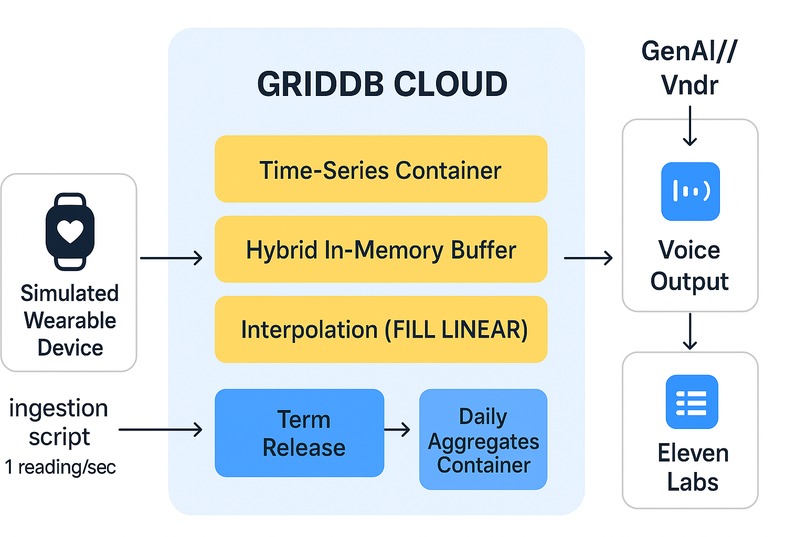
- IoT Ingestion Layer: We will use a simulated medical node (Python-based) to stream high-frequency sensor data (1 reading/sec) directly to the GridDB database to demonstrate real-time capabilities.
- Database Layer (The Core): GridDB Cloud will serve as the time-series engine. We chose GridDB over others because of its “Key-Container” model which allows us to isolate each patient’s data in memory for millisecond-level retrieval.
- Intelligence Layer:
- Google Gemini 1.5: Acts as the medical reasoning engine. It takes the raw JSON data from GridDB and generates a medically accurate, natural language summary.
- ElevenLabs: Converts that summary into a high-fidelity, empathetic voice response, reducing the “robot fatigue” often felt by elderly users.
Detailed GridDB Usage (Technical Plan)
We have designed our schema specifically to leverage GridDB’s advanced time-series features:
- Handling Data Gaps (Interpolation): Wearable devices often disconnect, creating data gaps. We will use GridDB’s native
GROUP BY RANGEwithFILL(LINEAR)function to mathematically reconstruct missing heart-rate data in real-time, ensuring our AI never hallucinates due to missing inputs. - High-Speed Ingestion: We will utilize GridDB’s Hybrid In-Memory architecture to buffer incoming high-velocity streams in RAM before flushing to disk.
- Privacy & Lifecycle (Term Release): To ensure compliance and manage storage costs, we will implement GridDB’s Term Release feature to automatically expire raw second-by-second data after 7 days, retaining only the daily aggregates for long-term trend analysis.
Challenges we anticipate
- Data Intermittency: Real-world sensors are bursty. We plan to solve this using GridDB’s time-series interpolation rather than writing complex application logic.
- Latency: Voice interfaces feel broken if they lag. By querying GridDB’s in-memory containers, we aim to keep the “Data-to-Voice” pipeline under 1 second.
What’s next for Vital-Vocal
If selected as finalists, we will deploy our local prototype to GridDB Cloud on Azure and integrate a live hardware demo using an ESP32 pulse sensor to demonstrate the end-to-end real-time pipeline in Bengaluru.
Built With
azure, docker, elevenlabs, google-gemini, griddb, iot