
Pre-Incident Intelligence
Real-Time Industrial Safety Monitoring with GridDB Cloud
Elevator Pitch
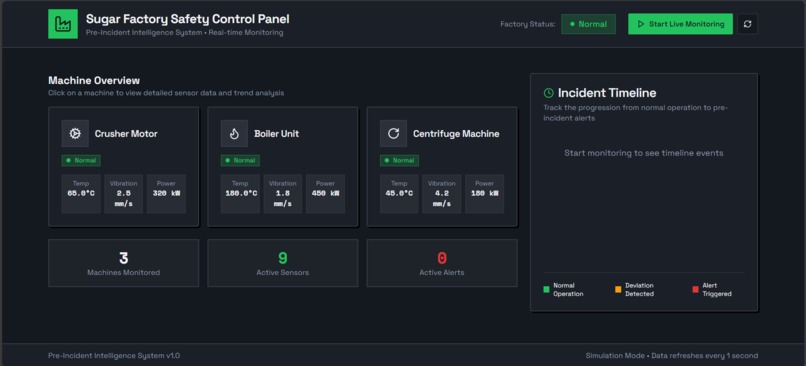
Pre-Incident Intelligence is a real-time industrial early warning system that continuously monitors machine sensors, correlates signals across multiple data streams, and detects unsafe patterns before standard alarms are triggered. Built on GridDB Cloud’s time-series architecture, it gives factory operators timely warnings, clear explanations, and actionable guidance to prevent accidents before they escalate.
Links
- Live Demo: sugar-vigil-safety.lovable.app
- Devpost Submission: Real Time Industrial Safety Monitoring with GridDB Cloud | Devpost
- Video Demo: https://youtu.be/duSSMFJZ7bY
About the Project
Motivation
In many factories, accidents do not happen suddenly — they build up over time.
Consider Ram, a factory worker operating a motor machine during a normal shift. At first, everything appeared fine. Over time, however, the machine began running slightly hotter and its vibration levels gradually increased. Each change, viewed in isolation, remained within allowed limits — so no alarm was triggered.
The problem was not a lack of sensors. The problem was that small warning signs were never connected together.
This inspired the team to build a system that detects early danger signs before an accident happens, not after.
Technical Architecture
System Components
1. Sensor Simulation Layer
- Simulated industrial sensors streaming temperature, vibration, and power consumption data continuously
- Realistic sensor behavior modeled to reflect real-world machine degradation patterns
2. Storage Layer
- GridDB Cloud – TIME SERIES containers
- Timestamp-based row keys for ordered, high-frequency ingestion
- Fixed schema for predictable, fast reads and writes
- Memory-first architecture with safe disk persistence
3. Backend / Analysis Layer
- Flask server ingesting and processing sensor streams
- Sliding time-window analysis correlating multiple sensor signals
- Rule-based early-warning logic:
- Individual sensor thresholds
- Multi-sensor correlation checks
- Pre-incident pattern detection
- Alert generation with explanations sourced from recent GridDB sensor history
4. Presentation Layer
- JavaScript web dashboard displaying:
- Live sensor values
- System status: Normal / Warning / Pre-Incident
- Recent alerts and incident timelines
- Operator acknowledgment workflow
How GridDB Powers the System
GridDB Cloud is the core of this project — not an optional component.
| Capability | Role in System |
|---|---|
| TIME SERIES containers | Store continuous sensor data with timestamp row keys |
| Memory-first ingestion | Handle high-frequency writes without bottlenecks |
| Efficient time-window queries | Power real-time correlation and early-warning detection |
| Sensor history access | Enable explainable alerts and incident replay |
| Multi-stream support | Correlate temperature, vibration, and power simultaneously |
Without GridDB:
- Real-time multi-sensor correlation would be slow
- High-frequency ingestion would create bottlenecks
- Incident replay and timeline reconstruction would be inefficient
Key Features
- Continuous ingestion from multiple simulated machine sensors
- Sliding time-window analysis across correlated sensor streams
- Pre-incident warnings issued before standard alarm thresholds are crossed
- Operator-facing alert explanations with suggested corrective actions
- Incident timeline replay for post-event analysis
- Acknowledgment workflow to confirm operator awareness
Challenges
- Designing thresholds that minimize false positives without missing real danger signals
- Simulating realistic, physically plausible sensor degradation patterns
- Keeping detection logic simple enough to be explainable to operators
- Ensuring smooth, low-latency real-time data flow during live demos
Impact
This system helps reduce industrial accidents by detecting unsafe conditions early — before failures or standard alarms occur. By giving operators timely warnings with clear explanations, it provides valuable response time before incidents escalate.
Beyond prevention, the system generates auditable incident timelines, enabling factories to learn from past events and refine safety protocols. Overall, it helps industrial operations shift from reactive safety to a proactive, preventive safety model.
Key Learnings
- How time-series data behaves in real-world industrial systems
- Why GridDB Cloud is well-suited to high-speed, high-frequency sensor workloads
- Why simple, explainable detection logic is more valuable than complex black-box models in safety-critical contexts
- How early multi-sensor patterns carry more signal than any single sensor value in isolation
What’s Next
The immediate next steps involve:
- Validating detection logic using expanded simulated sensor datasets
- Defining safety rule sets for additional machine types and failure modes
- Refining the dashboard to more clearly visualize sensor trends, alert causes, and recommended actions
- Demonstrating scalability across multiple machines and physical locations
Technology Stack
Backend
- Python
- Flask
Frontend
- JavaScript
Database
- GridDB Cloud (TIME SERIES)
Data & Visualization
- matplotlib
- pandas
APIs & Integrations
- GridDB WebAPI
- GridDB Python Client
Summary
Pre-Incident Intelligence demonstrates how GridDB Cloud’s time-series architecture enables a new class of industrial safety tooling — one that correlates sensor streams in real time, surfaces early warning patterns, and gives operators the context and time they need to act before accidents occur.