
MetroYukti (HackStreet)
Problem Statement
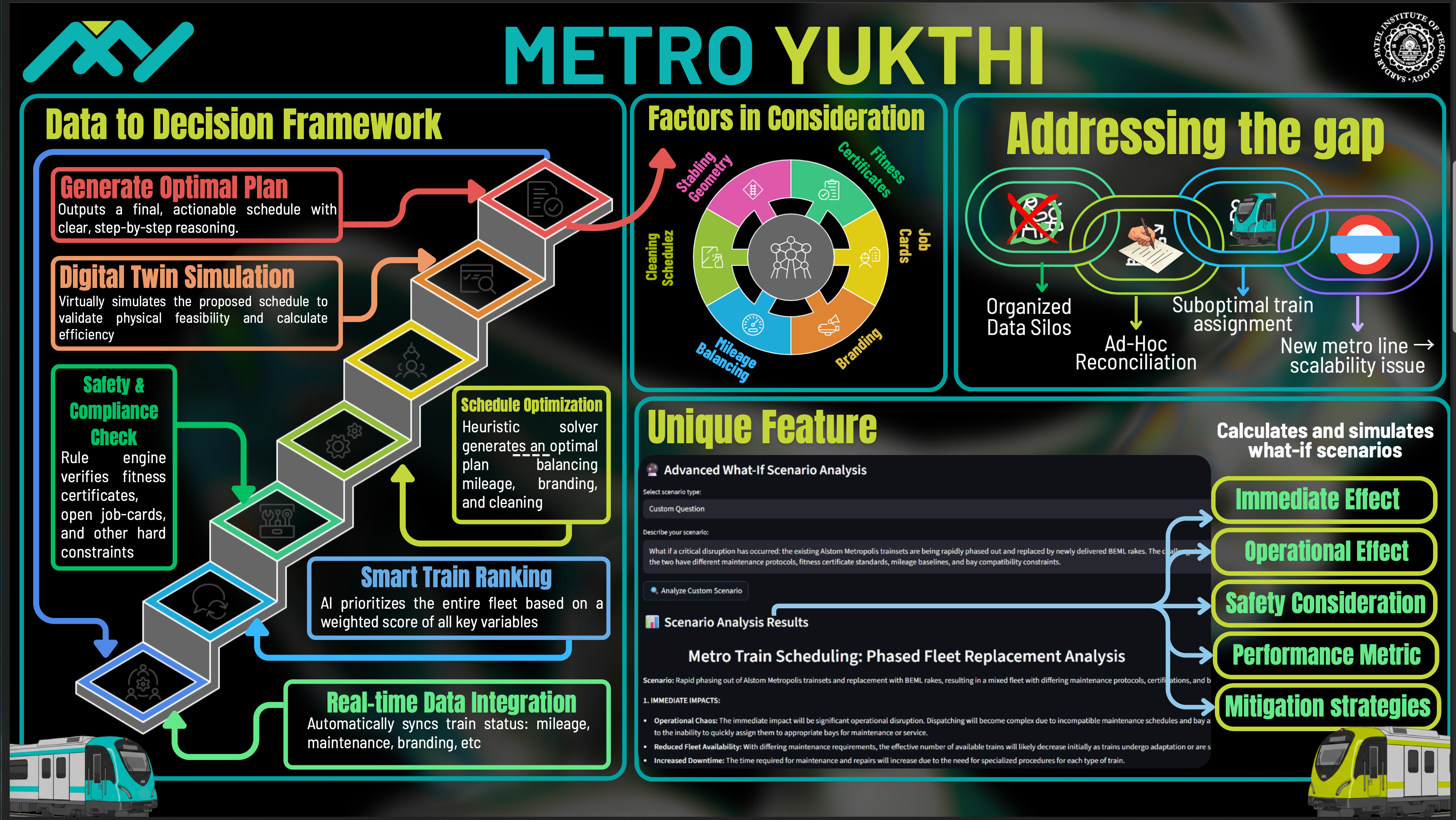
Rapidly expanding urban rail networks face a critical operational bottleneck: fleet scheduling. Balancing maintenance, safety, and commercial requirements is still largely handled using disjointed, manual systems.
This lack of digital integration is not just inefficient — it introduces significant financial and safety risks as networks scale.
The Scalability Crisis
Reactive Maintenance
- Unplanned repairs cost 3×–5× more than preventive maintenance
- Manual planning forces a reactive posture
Critical Dependency on Spreadsheets
- 94% of spreadsheets contain errors
- Manual data entry is the single largest point of failure in safety compliance
Growth Ceiling
- Fleet size grows linearly
- Operational complexity grows exponentially
- Manual teams cannot physically scale with network growth
Result:
- 15–20% annual inflation in operating budgets
- Capped network capacity despite infrastructure expansion
The Global Urban Rail Challenge
Fleet scheduling must simultaneously consider:
- Stabling geometry
- Train fitness certificates
- Job cards & maintenance status
- Branding & mileage balancing
- Cleaning schedules
- Operational service plans
Today, these exist as organized data silos, leading to:
- Ad-hoc reconciliation
- Suboptimal train assignment
- Increased safety and compliance risks
Solution Overview: MetroYukti
MetroYukti is an AI-powered decision system that generates safe, optimal, and feasible train induction schedules.
Key Capabilities
- Outputs a final, actionable schedule with step-by-step reasoning
- Converts raw operational data into real-time decisions
- Designed for scalability as new metro lines are added
Core Features
Smart Train Ranking
AI prioritizes the entire fleet using a weighted score across all key variables.
Safety & Compliance Check
A deterministic rule engine verifies:
- Fitness certificates
- Open job cards
- Hard operational constraints
Unsafe trains are eliminated before optimization.
Schedule Optimization
A high-speed heuristic solver balances:
- Mileage
- Branding commitments
- Cleaning requirements
Digital Twin Simulation (Unique Feature)
- Simulates the proposed schedule using SimPy
- Validates physical feasibility (shunting, grounding)
- Calculates performance metrics before execution
Real-Time Data Integration
Automatically syncs:
- Mileage
- Maintenance status
- Branding data
- Operational constraints
Technical Approach (Data → Decision Framework)
-
Input Validation
Validates daily train data, depot capacity, and operational objectives. -
Knowledge Retrieval
Retrieves SOPs, historical maintenance records, and past schedules from a vector database. -
Safety Analysis
Rule engine filters out trains failing hard constraints (expired certificates, critical job cards). -
LLM Ranking
Mistral-powered agent ranks safe trains using a Bayesian Neural Network (BNN). -
Heuristic Optimization
Generates an initial near-optimal assignment for:- Service
- Standby
- Maintenance
-
LLM Validation
Agent validates the generated plan against knowledge and constraints. -
Digital Twin Simulation
SimPy simulates real-world shunting movements and calculates KPIs. -
Final Output
Produces a structured JSON schedule with:- Performance metrics
- Validation results
- Reasoning logs
Technology Stack
Core
- GridDB
- Mistral AI
- React.js
Digital Twin & Optimization
- SimPy
- Heuristic Solvers
Mobile Applications
- Flutter / Dart
- Kotlin
- Swift
Data & Knowledge Layer
- PostgreSQL (Single Source of Truth)
- Vector embeddings (separate schemas)
Feasibility
- Integrates with existing systems (Maximo, IoT feeds, manual logs)
- No disruption to current operations
- Deterministic validation prevents parameter mismatches
- Rule engine cross-references:
- CBTC / ATO configurations
- Bay-specific protocol requirements
All safety decisions are auditable and immutable.
Viability
Rapid ROI
- Slashes maintenance costs
- Reduces manual planning from hours to minutes
Safety by Design
- Scheduling is strictly conditional on passing hardcoded safety checks
- Creates a permanent compliance log for every run
Predictive Maintenance
- Links job cards to real-time mileage
- Enables Just-In-Time (JIT) spare parts availability via API integrations
Single Source of Truth
- Centralized PostgreSQL database
- Eliminates data staleness and inconsistencies across tools
Impact & Benefits
Operational Impact
- Nightly induction time reduced from 3.5 hours to ~20 minutes
- Faster, auditable scheduling with fewer human errors
Energy & Asset Efficiency
- 5–15% traction energy savings (benchmarked up to 25%)
- Reduced deadhead shunting and asset wear
Maintenance
- 30–50% reduction in downtime
- 15–25% lower maintenance costs
Revenue Protection
- Protects non-fare revenue (~20% at DMRC)
- Honors branding commitments with reliable inventory
Passenger Experience
- Fewer last-minute cancellations
- Improved punctuality during peak hours
- Higher passenger trust
Broader Benefits
Social Benefits
- Reliable, punctual services
- Smoother, disruption-free journeys
Economic Benefits
- Reduced costs
- Protected revenue streams
- Improved financial sustainability
Environmental Benefits
- Energy-efficient train deployment
- Smarter workload balancing
- Lower overall system strain
Summary
MetroYukti transforms metro fleet scheduling from a manual, error-prone process into a safe, AI-driven, and digitally validated system. By combining GridDB-powered data integration, deterministic safety checks, AI optimization, and digital twin simulation, the solution delivers scalability, safety, and measurable operational impact for modern urban rail networks.
Thank You
HackStreet – MetroYukti