
Aetherra
Aetherra is a climate MRV (Measurement, Reporting, and Verification) system that enables continuous, audit-ready carbon verification using real-world sensor time-series data.
Current carbon MRV processes rely heavily on manual surveys, assumptions, and infrequent audits, making verification slow, non-transparent, and inaccessible to small farmers and grassroots projects.
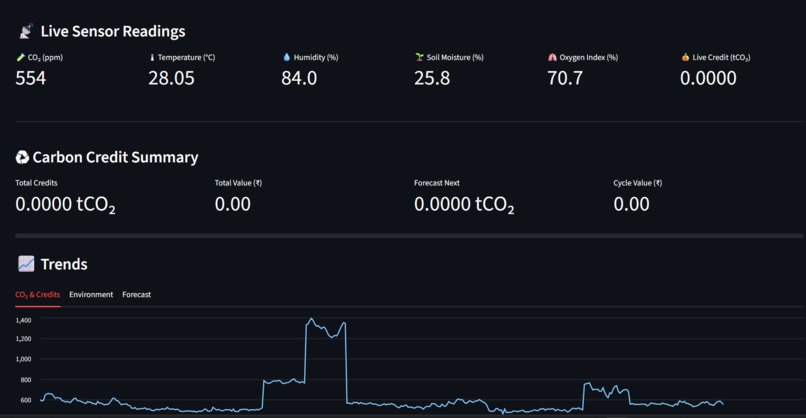
Aetherra solves this by collecting tree-level environmental data (CO₂, proxies, soil moisture, temperature, humidity) through low-cost sensors, storing it in GridDB time-series containers, and visualizing it through live dashboards. This allows environmental impact to be measured continuously, reported digitally, and verified transparently.
The project demonstrates how GridDB is well-suited for climate-critical time-series workloads, where precision, reliability, and long-term data integrity are essential.
Inspiration
Carbon credit verification is extremely broken. Today:
- Verification is slow.
- Data is manual.
- Reporting is non-standardized.
- Small farmers cannot access carbon revenue.
We asked: “What if MRV could be continuous, automated, and backed by real-time environmental data?”
Aetherra was born from that question — an IoT-powered MRV system that stores climate signals into GridDB, enabling transparent, timestamped evidence for carbon credits.
What Aetherra Does
Aetherra is a real-time MRV data pipeline designed for carbon credit projects and agroforestry systems.
Our system:
- Collects real sensor-like climate data:
- Temperature & Humidity
- CO₂ ppm
- Soil moisture & Pressure
- Tree/plot identifiers
- Accurate timestamps
- Stores all records in GridDB Community Edition, using:
- Time-series containers
- High-frequency inserts
- SQL WebAPI
- Fast queries for dashboards
- Generates MRV-ready time-series logs:
- For issuing carbon credits and verifying field conditions.
- For auditors, registries, and digital carbon passport creation.
Everything is done continuously, not manually — making MRV affordable and scalable.
How We Built It
1. Sensor Simulator (IoT Node)
A Python script simulates a real MRV sensor device sending data packets. This imitates real-world agroforestry sensor hardware.
{
  "tree_id": "T001",
  "temperature": 28.5,
  "humidity": 75.9,
  "pressure": 1012,
  "soil": 435,
  "co2": 412
}