
AAROK
Inspiration
[cite_start]The contemporary healthcare systems find it hard to monitor patients in real-time, particularly in distant or resource-constrained settings[cite: 259]. [cite_start]We have tried to develop a low-priced, dependable, and scalable IoT healthcare system that would be able to monitor vitals such as heart rate, SpO2, and body temperature and store the information in a high-performance cloud database[cite: 260].
What it does
AAROK is a real-time patient health monitoring system that:
- [cite_start]Collects Vitals: Heart Rate (MAX30102), SpO2, and Temperature (LM35) powered by ESP32 [cite: 263-267].
- [cite_start]Sends Data Wirelessly: ESP32 transmits WiFi data in a cycle in the form of JSON[cite: 268, 269].
- [cite_start]Stores in GridDB: A lightweight Python server receives the data and stores it in a time-series optimized GridDB[cite: 271].
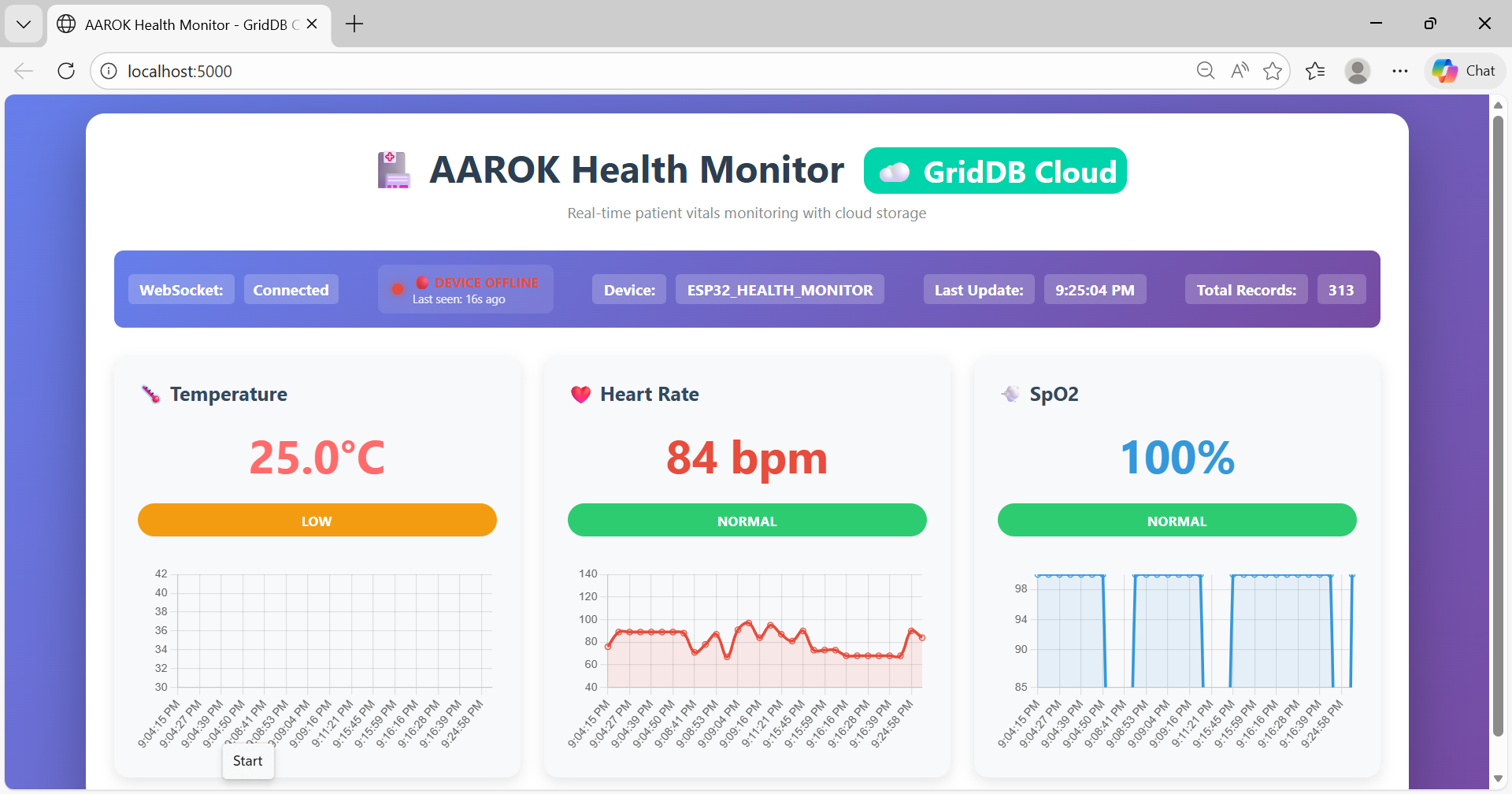
- [cite_start]Provides Live Monitoring: Real-time dashboard with latest readings, trend analysis, and alerts for unnatural values [cite: 272-276].
How we built it
- [cite_start]Hardware Layer: ESP32 reads data from MAX30102 and LM35, calculates values, and packages data into JSON [cite: 287-290].
- [cite_start]Communication Layer: ESP32 uses HTTP POST over WiFi to send measurements to the backend [cite: 291-293].
- [cite_start]Backend Layer: A Python Flask REST API validates inputs, stores data into a GridDB time-series collection, and provides endpoints for data retrieval [cite: 295-299].
- [cite_start]Frontend Layer: An HTML dashboard (using Chart.js) visualizes live Heart Rate, SpO2, and Temperature with color-coded alerts [cite: 300-306, 356].
Challenges we ran into
- [cite_start]Sensor Accuracy Issues: MAX30102 required precise finger placement; solved with multi-sample averaging[cite: 314, 315].
- [cite_start]GridDB Cloud Integration: Overcoming the learning curve for authentication and REST API time-series insertion[cite: 316, 317].
- [cite_start]Real-time Synchronization: Managing timing between hardware, server, and dashboard to prevent data loss[cite: 318, 319].
- [cite_start]Device Status Tracking: Implementing timeout detection to distinguish offline devices from network delays[cite: 320, 321].
- [cite_start]WiFi Connectivity: Resolved ESP32 connection drops with automatic reconnection logic[cite: 322, 323].
Accomplishments that we’re proud of
- [cite_start]Real-time Monitoring: Achieved under half-a-second sensor-to-dashboard response with live WebSocket information[cite: 327].
- [cite_start]GridDB Cloud Integration: Successfully mastered the time-series database to stream IoT data continuously[cite: 328].
- [cite_start]Intelligent Tracking: Integrated automatic offline detection for reliable monitoring[cite: 329].
- [cite_start]User-Friendly Dashboard: Developed a simple, color-coded interface accessible to non-technical users[cite: 330, 338].
- [cite_start]Affordable Access: Created a solution with the potential to save lives in rural and underserved locations[cite: 340, 341].
What we learned
- [cite_start]IoT hardware integration (ESP32, MAX30102, LM35)[cite: 344].
- [cite_start]Time-series database implementation with GridDB Cloud[cite: 344].
- [cite_start]WebSocket real-time communication[cite: 345].
- [cite_start]Standards of healthcare data accuracy and reliability[cite: 346].
- [cite_start]Full-stack development from embedded systems to web dashboards[cite: 347].
What’s Next
- [cite_start]Addition of more vital signs such as ECG and blood pressure[cite: 349].
- [cite_start]Creating AI-driven health predictions based on historical data in GridDB[cite: 350].
- [cite_start]Initiating pilot projects with rural clinics and aiming for medical device certification[cite: 350, 351].
Built With
chart.js, css, esp32, flask, griddb, html, http, javascript, lm35, max30102, python, websocket, wifi
Organization
[cite_start]Gooroo Mobility India (GMIndia) [cite: 237]
Created by
- [cite_start]Vijay S [cite: 243]
- [cite_start]Vishnu Kumar AR [cite: 246]